Base material · Chandigarh
Swiss Lace Base in Chandigarh
Would we recommend it here?
Yes — this is a sound choice for Chandigarh.
Swiss lace is the base that makes coastal wear tolerable. Air passes straight through the mesh, so sweat evaporates instead of pooling under the base, and Mumbai clients report far less itching through the monsoon than they do on poly. The trade-off is fragility: lace is unforgiving of the impatient dry removal that humidity tempts people into. In Pune the same base lasts noticeably longer simply because it is handled less often.
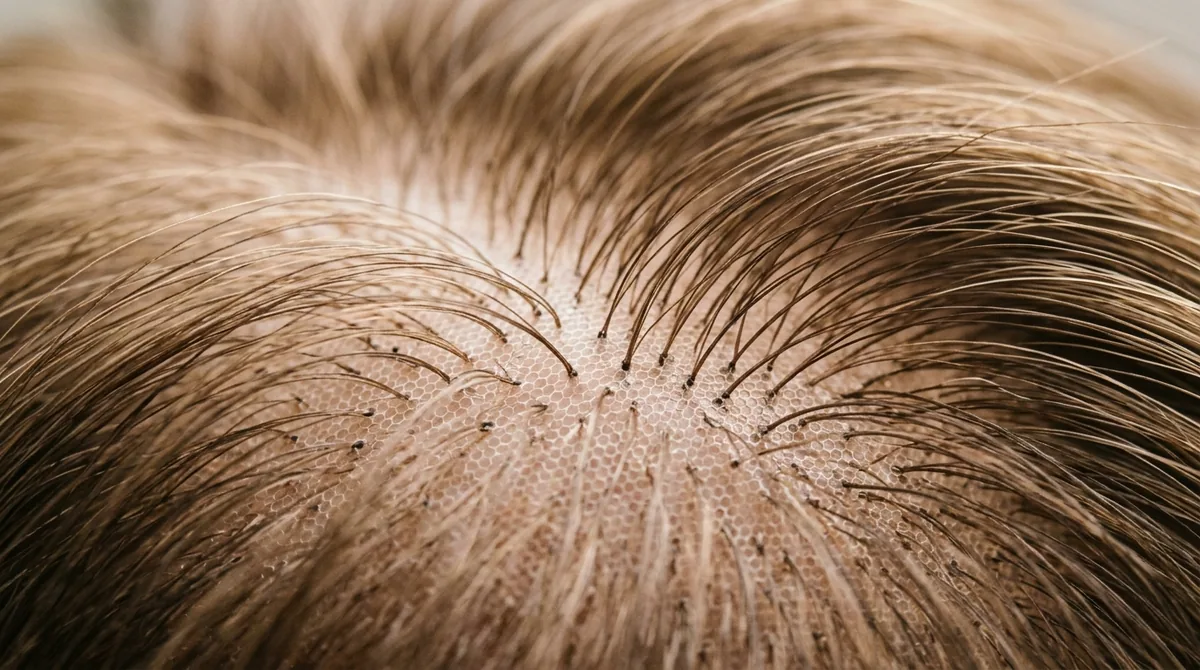
Most people who come to us from Chandigarh looking for lace hair patch have already tried a ready-made piece that did not sit right. Fine Swiss lace that disappears against the scalp and lets air through. The softest front hairline available, and the first choice for humid coastal wear.
Our fittings run to a fixed price band, so there is no upsell on the chair.
- Lifespan
- 3–6 months of daily wear
- Service interval
- Every four to eight weeks
- Best for
- Front hairlines and anyone who sweats heavily.
Caring for a swiss lace base in Chandigarh
The other factor unique to this belt is the October-November stubble-burning season across Punjab and Haryana, which pushes Chandigarh's air quality close to Delhi's for several weeks and settles fine particulate into hair and base fibres fast. We push servicing frequency up in that window and again through peak summer heat, and let it ease slightly in the cooler November-February stretch outside the fog and dust spells.
- Remove with solvent only - Swiss lace tears the moment it is pulled dry.
- Dab, never rub, when cleaning adhesive out of the knots.
- Keep the front hairline out of direct sun where you can; UV weakens fine lace faster than sweat does.
- Book a perimeter check every second re-bond; small lace splits are repairable, large ones are not.
Where we fit it in Chandigarh
There is no HairSystems studio in Chandigarh; the entire tricity is served through home visits, scheduled on fixed zone days rather than arranged one at a time. Free doorstep consultation across the Chandigarh tricity, Panchkula to Zirakpur.
Send your details and we will call back with a recommendation and an honest price band.
Ask about a swiss lace base in Chandigarh
Tell us how much you sweat and how you commute — those two answers decide whether this is the right specification for you more than anything else.
Swiss Lace Base in Chandigarh — FAQs
- Does a swiss lace base work in Chandigarh?
- Yes. Front hairlines and anyone who sweats heavily. In Chandigarh it holds its quoted lifespan of 3–6 months of daily wear provided it is serviced every four to eight weeks.
- How long does a swiss lace base last in Chandigarh?
- 3–6 months of daily wear is the quoted range. Chandigarh wearers routinely reach the upper end, because drier air means less sweat against the base and a longer interval between removals.
- How often would I service it in Chandigarh?
- Every four to eight weeks — about 9 visits a year. Every visit includes a scalp check and a perimeter inspection, not just a re-bond, because that is when small problems are still cheap to fix.
Services offering a swiss lace base in Chandigarh
Compare and explore
- Swiss Lace Base in Mumbai
- Swiss Lace Base in Navi Mumbai
- Swiss Lace Base in Panvel
- Swiss Lace Base in Thane
- Swiss Lace Base in Pune
- Swiss Lace Base in Delhi
- Swiss Lace Base in Gurugram
- Swiss Lace Base in Bangalore
- Swiss Lace Base in Hyderabad
- Swiss Lace Base in Chennai
- Swiss Lace Base in Coimbatore
- Swiss Lace Base in Kolkata
- Swiss Lace Base in Patna
- Swiss Lace Base in Ahmedabad
- Swiss Lace Base in Surat
- Swiss Lace Base in Vadodara
- Swiss Lace Base in Jaipur
- Swiss Lace Base in Lucknow
- Swiss Lace Base in Kanpur
- Swiss Lace Base in Nagpur
- Swiss Lace Base in Nashik
- Swiss Lace Base in Indore
- Swiss Lace Base in Bhopal
- Swiss Lace Base in Visakhapatnam
- Skin (Poly) Base in Chandigarh
- French Lace Base in Chandigarh
- Monofilament Base in Chandigarh
- Silk Top Base in Chandigarh
- Swiss Lace Base — full specification guide